


What do Joe Rogan, Charlie Sheen and Charlie Kirk have in common?
On many levels, the correct answer is, “Not much.” And I never thought that I would be discussing Sheen in the context of someone like Kirk who, whatever you thought of his MAGA messages, was maturing into an increasingly effective public apologist on topics of faith, family and public life.
So, what unites Rogan, Sheen and Kirk? It’s this:
“Congress shall make no law respecting an establishment of religion, or prohibiting the free exercise thereof; or abridging the freedom of speech, or of the press; or the right of the people peaceably to assemble, and to petition the Government for a redress of grievances.”
Kirk was gunned down, according to the early evidence, by a dark-Web Antifa disciple while debating a polite, rational critic about the sharp rise in political violence in America.
With this event, we are talking about free speech, the free exercise of religious convictions and a massive, voluntary public assembly. In terms of Bill of Rights doctrine, this was the First Amendment trinity in action — at the same time, in the same place, on a university campus that is supposed to be a safe zone for debate and education.
For several days, I have been reading and listening — primarily heeding the words of Kirk himself and people on the true First Amendment left who have been defending him and even mourning his loss. Of course, I have also followed the prayer vigils and the events surrounding Kirk’s widow and family. Her speech last night was agonizing, brave and, yes, an act of faith.
Now, back to Rogan and (I can’t believe that I am typing this) Sheen.
Yes, there plenty of furious F-bombs in the Rogan video (embedded above). But look at the man’s face and listen to the pain and shock in the voice of this old-school free speech liberal. To my amazement, Sheen knew who Kirk is, and then was, and is clearly horrified when Kirk’s death was announced.
It is one thing to see Kirk’s close friends, such as broadcaster Megyn Kelly, crying on live, streamed video. Rogan and Sheen only knew Kirk through mass media. Nevertheless, it’s clear that both men (click for Page Six feature at The New York Post) totally understood the First Amendment context of this assassination.
A visibly distressed Rogan informed Sheen of the news of the shooting and the political commentator’s passing live on-air, to which the actor responded, “Murdered for having a different opinion from somebody else, different ideology from somebody else. Rest in peace.”
Sheen added that Kirk “didn’t deserve” to be killed.
“He’s not a violent guy. He was talking to people on college campuses. Wasn’t even particularly rude. He tried to be pretty reasonable with people,” Rogan argued.
“Whether you agree with him or not, and there was a lot of stuff I didn’t agree with him on, you’re allowed to disagree with people without celebrating the fact they got shot.”
Sheen agreed with Rogan’s sentiment, saying he believes Kirk’s assassination will put other political commentators “on guard” from speaking out and could be a “tipping point moment” in history.
As I said earlier, I have been reading a wide range of commentary and tributes about Kirk. However, I am glad that I do not have a Blue Sky account, because the hellish celebrations there — I have seen screenshot collections — have been truly scary.
I get that part of the illiberal left is dancing, right now. But that’s not what is happening among many of those who call themselves liberals, and actually mean it.
I think one of the best ways to understand the man Kirk had become was to see him sitting across from an almost stereotypical old liberal like Bill Maher. Their disagreements are many and important.
However, if you don’t have time to watch all of that Club Random episode with Maher and Kirk, jump to the 1 hour and 18 minute mark — where they begin a discussion of the importance of the Resurrection of Jesus — and watch to the end. Why do Christians say, “Christ IS Risen”? Kirk stands firm.
The final discussion focuses on defending the legacy of Western Civilization, even if that means facing angry students, faculty and administrators on college campuses. Kirk says these campus debates are at the heart of what he is called to do. He won’t stop going. Period.
If you are wondering what Kirk thinks during these kinds of conversations, you don’t have to guess — since he posted his own analysis of the talk with Maher.
Once again, many readers will not have the time to watch all of that video, either. But if you want to know more about the maturing voice of Kirk, this is one of the encounters that is worthy of study.
Why should traditional Christians focus on Kirk’s willingness to debate voices on the other side of the political, cultural and theological aisle? There’s an obvious reason: Kirk had not surrendered. He was not going to swim in despair. He wanted to know what other people thought and believed, because he wanted to reach out to them.
This Digital Liturgies post by Samuel D. James — “How Great the Chasm That Lay Between Us” — really spoke to me and many others. Here is the part that is hard to read, but it’s essential for believers who want to be Rational Sheep:
The world that Charlie Kirk and his youngest listeners inherited is a world which has masturbated itself numb to God. It is a world where lonely, disaffected, angry, adrift young men peel away from lonely, materialistic, selfish young women. It is a world where the violent walk free lest judges or asylums “stigmatize” them. It is a world where not even the grisly public murder of a husband and father can be grieved without some kind of disclaimer. Ours is a brutally inhumane time. And the only way out of it begins by looking at the ruling ideas and institutions of this inhumane time, and rejecting them in favor of something better. …
Christians … have an opportunity to learn from Charlie Kirk: Not all his politics, but all his boldness, all his willingness to engage, all his energy to speak of things eternal to a culture unwilling to listen.
In the hours since Charlie Kirk’s death I’ve been thinking of a phrase from a song we sing at my local church. The song is “Living Hope” by Phil Wickham. The first stanza describes fallen humanity:
“How great the chasm that lay between us
How high the mountain I could not climb
In desperation, I turned to heaven
And spoke Your name into the night”
Now, if you want to see more examples of how Kirk’s work affected a few important minds on the cultural left, keep reading.
First, there is this piece of an editorial from The Free Press leadership:
With increasing urgency and horror, we have been covering the terrible upsurge in political violence that threatens to tear our country apart. Yesterday came the most shocking example yet: the assassination of 31-year-old Charlie Kirk, who founded Turning Point USA and drew thousands of young people to conservatism.
He was murdered while speaking to a crowd of some 3,000 students at Utah Valley University. He was standing under a canopy that read “PROVE ME WRONG,” urging students to debate him. He was the living embodiment of the First Amendment. …
Political violence has become far too common in recent times, and we will continue to call for America to recapture values that will help lower the political temperature. Values like family and faith and a genuine reverence for free speech. Values that Charlie Kirk held dear.
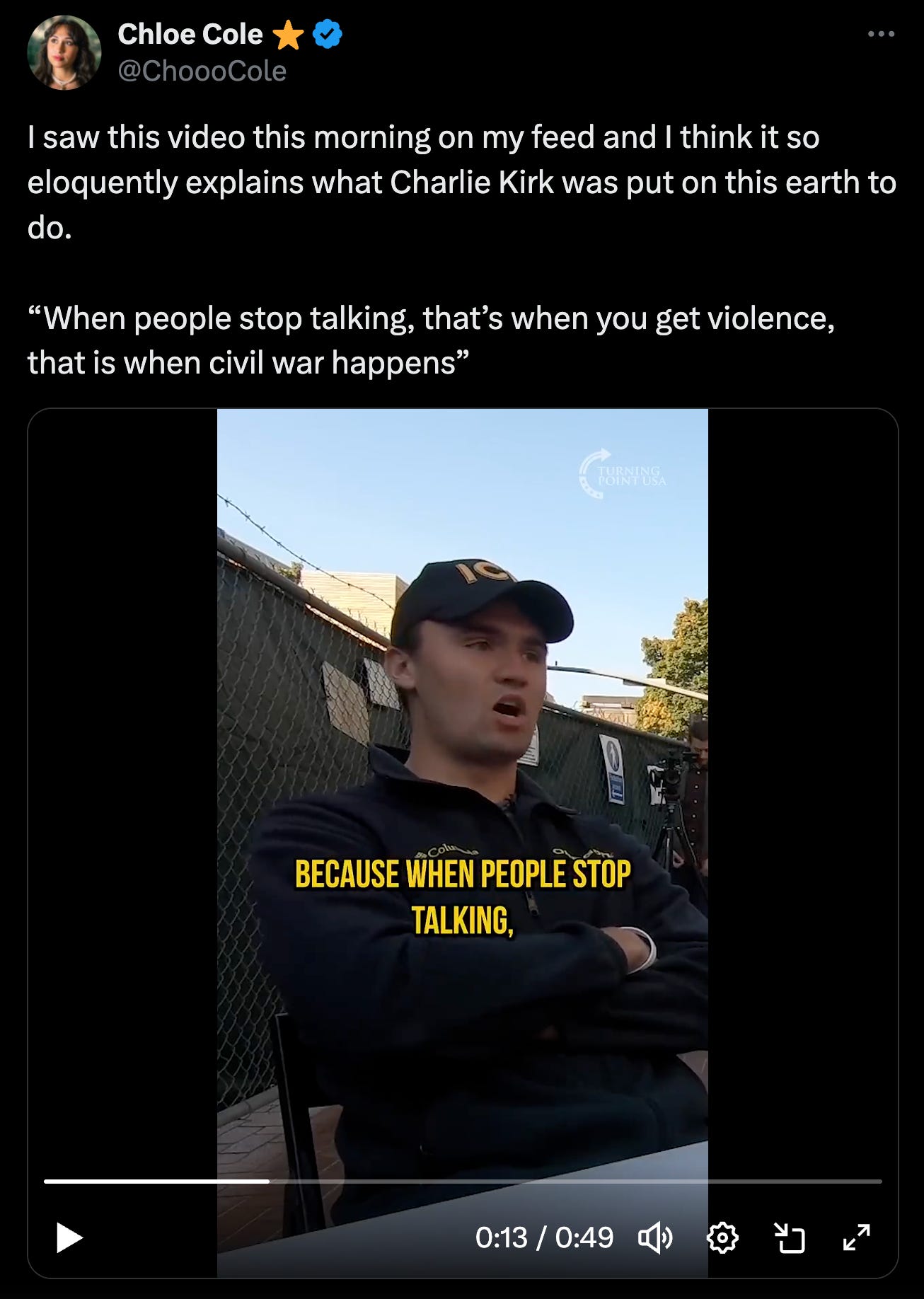
The key was one of Kirk’s cornerstone beliefs, which he articulated many times in many different ways. Such as:
“[W]hen people stop talking, really bad stuff starts. When marriages stop talking, divorce happens. When civilizations stop talking, civil war ensues. When you stop having a human connection with someone you disagree with, it becomes a lot easier to want to commit violence against that group. … What we as a culture have to get back to is being able to have a reasonable disagreement where violence is not an option.”
Kirk knew that he was taking risks.
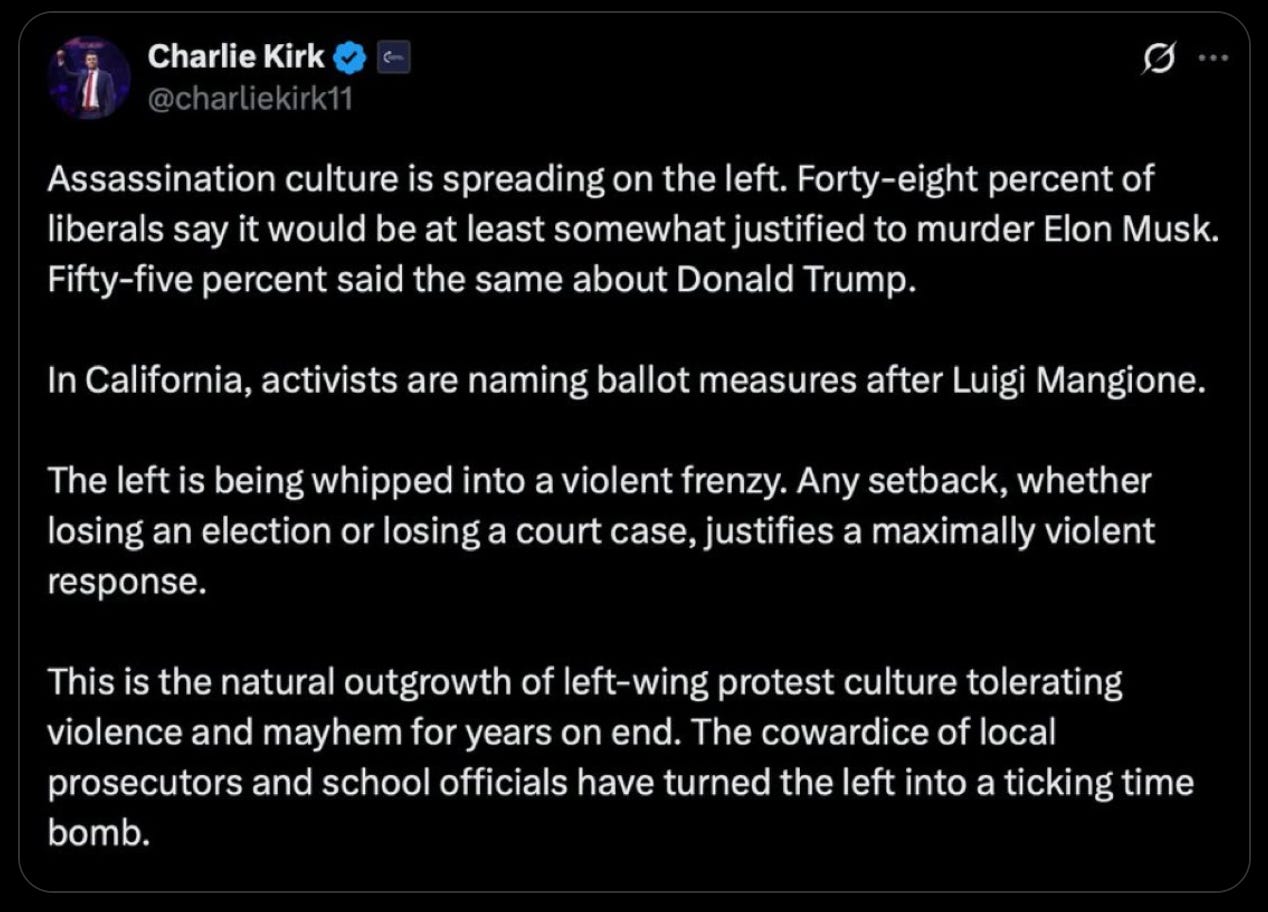
Kirk was struck down while engaged in a polite conversation with a critic in the Utah audience. The topic: The rise of political violence, especially among many on the far left — such as online militant trans networks.
It was a discussion worth having, according to Andrew Sullivan, one of the world’s most articulate gay-rights activists and apologists. See his must-read essay: “Hitting The Jugular Of Liberal Democracy.” Here is a crucial passage:
Here is the exchange that directly preceded the assassination of Kirk:
Question: Do you know how many transgender Americans have been mass shooters over the last 10 years?
Kirk: Too many.
Question: Do you know how many mass shooters there have been in America over the last 10 years?
Kirk: Counting or not counting gang violence ... ?
His last words were those of a classic “master-debater,” as South Park recently quipped — a joke Kirk enjoyed. What he had “mastered” at 31 years was a staggeringly comprehensive data-set in his own head of every single stat or detail of any number of policies that he could deploy to win any argument with a woke college sophomore. Like Ben Shapiro, he could rattle off any number of gotchas — and obscure Bible verses — and barely break a sweat.
This wasn’t exactly wisdom; but it wasn’t entirely sophistry either; and in a university climate that remains so intellectually repressive, where the new orthodoxy is that free-wheeling debate is just another form of structural “oppression”, it was a blessing. And when I went back this week and caught up on Kirk’s videos, debates, and events, I was far more often impressed than dismayed. He treated opponents with respect. He looked them in the eyes. He made arguments — and the young victims of woke indoctrination, rather than arguing back, called it “hate”. …
We should all grieve Charlie Kirk — because free speech vs violence is much more crucial a divide than left vs right. And the proper response to this horror is serious introspection about how violence has burrowed its way into our widening, post-liberal gyre.
What about the viewpoint of that young man on the other side of the final exchange?
Sullivan is one of many people online who — though they radically disagreed with Kirk on essential issues — are offering warm tributes because of their respect for the role that he played in American discourse.
Let’s look at one or two more, starting with “The Charlie Kirk I Knew” by Adam Rubenstein at The Free Press. This essay includes a description of what happened after he wrote a piece that was critical of Kirk, but took him seriously:
The profile was fair, and by no means a puff piece. And while his flack reached out to me to tell me that I was a Never Trump reptile (or something like that), Charlie texted me a link to my own story and said, “Well done!”
That was Charlie. If I had to use a single word to capture him, it would be gracious. We could disagree about anything — and we did — but he would, without fail, engage civilly and explain his point of view. He did not do this, as many do, to make himself feel smart. He did it so he could share the other side of something he cared about. And he cared deeply.
That’s the spirit he took to the hundreds of campuses he visited. Not denunciation. Not shouting down. Never an insult. He sought to debate ideas, and did so in hostile territory.
That was even true in the most hostile of territory, such as this memorable visit to the legendary Oxford Union. Some of the exchanges from that session rumble to this day.
But I will end, believe it or not, with an op-ed from The New York Times.
Ezra Klein wrote an essential piece with this title: “Charlie Kirk Was Practicing Politics the Right Way.” Read it all: Because that’s exactly what Kirk would do.
But here is one final thought from the left, before I go back to reading more about this, yes, potential turning point in American public life. Klein writes:
You can dislike much of what Kirk believed and the following statement is still true: Kirk was practicing politics in exactly the right way. He was showing up to campuses and talking with anyone who would talk to him. He was one of the era’s most effective practitioners of persuasion. When the left thought its hold on the hearts and minds of college students was nearly absolute, Kirk showed up again and again to break it. Slowly, then all at once, he did. College-age voters shifted sharply right in the 2024 election.
That was not all Kirk’s doing, but he was central in laying the groundwork for it. I did not know Kirk, and I am not the right person to eulogize him. But I envied what he built. A taste for disagreement is a virtue in a democracy. Liberalism could use more of his moxie and fearlessness. …
Kirk and I were on different sides of most political arguments. We were on the same side on the continued possibility of American politics. It is supposed to be an argument, not a war; it is supposed to be won with words, not ended with bullets. I wanted Kirk to be safe for his sake, but I also wanted him to be safe for mine and for the sake of our larger shared project.
The bottom line, Klein argued, is this: “We are all safe, or none of us are.”
Very grateful for the depth and breadth of opinions you cover here. Having some solid leads is so helpful when you want to start piecing together the full story.
There was an article posted on Dispatch Faith (Michael Reneau) that came closest to my reaction to Kirk's murder. I knew nothing about Kirk, aside from recognizing his name. He says, "though we shared theological commitments, the disagreements I had with him on practical matters—the outgrowth of those theological commitments—were vast." I can put this another more secular way, even if Kirk was a congenial and personal person, who was willing and ready to listen to others, that doesn't entail that I and others can't have serious problems with the positions that he took.
Reneau adds, "How do people who agree on so many foundational questions—who we are, who God is, what is wrong with the world and ourselves, and how does it all get fixed—diverge on such substantive, consequential questions?"
Just as importantly, how do you treat and deal with people who we regard as Christian brothers and sisters, and yet have sincere and strong disagreements in the political arena? I am reminded by something Taylor says in A Secular Age. He argues that during the Middle Ages there was a consensus that there were two Kingdoms of God: the earthly and the heavenly. In the earthly there are roles, hierarchies, kings, peasants. There was inequality, but before God we were all equal. This affirmation helped to establish a sense of "communitas": that we are all in this together in spite of inequality that prevails in the earthly realm.
Today things are different. This is the point and the worry expressed in Peggy Noonans' article in the Wall Street Journal:
"For those of us who remember the 1960s and the killing of Medgar Evers, both Kennedys and Martin Luther King, it feels like we're going through another terrible round of political violence. It's tempting to think, "That was terrible but we got through it." But the assassinations of the 1960s took place in a healthier country, one that respected itself more and was, for all its troubles, more at ease with itself. It had give. Part of why this moment is scary is that we are brittler, and we love each other less, maybe even love ourselves less."
Renau ends his article with this reflection:
"If Americans do love each other less, we need something to teach and help us to love one another again, despite the furor. So now is precisely the time to keep repeating to ourselves the moral platitudes we should already know yet need to hear again and again. That murder is always evil. That Americans do have bonds that can transcend our real and consequential differences in everything from sexual mores to tax policy. And that feeding each other's malice will only end in tragedy."
The question is whether there really remains anything left in the American imaginary that is really transcendent and still be able to bind us together despite our minute differences?