


Let’s start this Narnia wars post with a few words of wisdom from director Peter Jackson, drawn from a face-to-face chat with some reporters (including me) during press events for one of The Lord of the Rings epics.
By the way, this piece will be quite long and I ask for readers to be patient.
The goal of his team, Jackson said, was to leave the foundations of J.R.R. Tolkien’s myth intact, to capture the timeless quality of the author’s vision.
“We didn’t make it as a spiritual film, but here is what we did do,” said Jackson, who is a co-writer and co-producer as well as the director of the project. “Tolkien was a very religious man. But we made a decision a long time ago that we would never knowingly put any of our own baggage into these films. ...
“What we tried to do was honor the things that were important to Tolkien, but without really emphasizing one thing over another. We didn’t want to make it a religious film. But he was very religious and some of the messages and some of the themes are based on his beliefs.”
Along with other members of the LOTR team, Jackson stressed that everyone knew that it made little or no sense — including box-office realities — to infuriate the massive, loyal world of people who love Tolkien’s work.
This leads me to the question I have been asked repeatedly once the word leaked that director Greta Gerwig had cast Meryl Streep to voice the role of Aslan: “Will you head to a theater to watch Gerwig’s version of ‘The Magician’s Nephew’?”
It helps to know that this is my favorite “Chronicles of Narnia” book. Our home contains quite a bit of Narnia-related art. Our son’s middle name is “Lewis.” Thus, my answer: “No. I will not buy a ticket. I will take notes while watching whatever reaches Netflix.” Also, I predict that our grandchildren will not be rushed to see the adventures of Ziggy Aslan. Hold that thought.
Way, way back — Aprl of 2025 — I read this piece by Sam (SDG) Morgan: “Roar (Politely) for Aslan.” It offered calm advice concerning the rumors about the Aslan gender swap (of one form or another). I immediately began writing a Rational Sheep post and never finished it. I needed more on-the-record information.
From his point of view, including work as a filmmaker, Morgan noted (I have added some bold text):
Netflix, first, allowed a leak of the news [about Streep] on April 1st to mitigate it, and see how viral the reaction went. Did it seem like a big joke to everyone? How much blowback was there on social media? Netflix then gauged that reaction, about a week later allowed one of the legit Hollywood magazines to partially confirm the casting. But that legit article went out of its way to be very vague … this was intentional.
Rest assured, someone very highly placed in Netflix really likes this casting choice and really wants to do it. However, someone else highly placed is very worried about it … so this is the strategy they have decided upon to gauge the damage to their multi-million dollar investment.
Morgan urged pro-Narnia warriors to be polite and smart. I thought his wording in this next part was spot on: “… Let’s be clear, Ms. Streep is an inimitable actress, and extremely talented and it would be a huge win for the Narnia project to have her involved … in any other capacity except for Aslan’s voice.”
Needless to say, it’s safe to say that Netflix didn’t want to ask Gerwig to fire Streep. And Netflix didn’t want to fire Gerwig.
Morgan offed a number of addresses for people that Lewis readers could contact at Netflix and other power centers. But he also added this:
C.S. Lewis Company
— Melvin Adams (Director of The C.S. Lewis Company)
— Rachel Churchhill: rachelchurchill@narnia.com
THE C.S. LEWIS COMPANY LTD
Acre House, 11/15 William Road, London, NW1 3ER
As you would imagine, there were numerous reactions to his post, leading to this late May, 2025, sequel: “Why Roar (Politely) for Aslan?”
… [T]his casting choice is still vitally important for a few reasons. If they cast Meryl Streep as Aslan, they’ll presumably be tied to that choice for all their movies. And Ms. Greta Gerwig, no matter what other choices she makes in her two Narnia films is only contracted to make two films.
A new director will come in later, and they will likely have a new direction. However, this new director would already be tied to the voice casting choice for Aslan before they could ever start their vision for Narnia. After all, Aslan is the only character to recur in all of the Narnia stories.
And the half billion that Netflix paid for the rights to Narnia means that for at least ten more years (but more likely twenty-five or so) all film and TV rights for Narnia will be owned exclusively by Netflix. (Unless anyone else has a spare half-billion to buy it off them? Anyone?)
That’s a whole generation of impact, for good or bad. The cultural impressions of Netflix Narnia won’t only impact Narnia alone, but they’ll impact an entire generation’s thinking toward C.S. Lewis, and thereby all his apologetic works.
The question that matters the most: Is there a clause in the Netflix contracts that C.S. Lewis Company leaders can use to change the future, if Gerwig’s first flick turns the Narnia world upside-down, and not in a good way.
The next strategic questions are (1) can the Aslan casting change in the next movie and (2) will Gerwig CHOOSE to move forward? Will she make “The Lion, the Witch, and the Wardrobe,” with it’s blunt metaphors for the life, sacrificial death and resurrection of Narnia’s Christ figure?
Oh, and remember that she has already changed the timeline for the pivotal Narnia books to take place in the Sixties, not World War II England. It certainly appears that we are headed to Woodstock Narnia.
Now, Rational Sheep readers will — after reading the earlier Jackson quotes — know where I am headed. Is it time to ask if we can add “The Chronicles of Narnia” to the list of sad Tinseltown tales described in my post “Age of the crashing Hollywood empires” and its sequels?
For background, here is the key material we need to revisit, drawn from my post: “What is Job 1, when you run a pop super-franchise?”
Is Job 1 to please the core fans that made your product a profitable franchise in the first place? Is it to be faithful to the source material for the franchise, whether we’re talking about classic books, comics, foundation films or whatever? Should managers be faithful to the “canon” of a franchise, to its core principles and worldview? Can they build on it while being faithful to the past?
Or is Job 1 finding a way to EXPAND the franchise into a new generation, reaching the “modern audiences” that allegedly represent the future? After all, the folks in the 18-40 demographic of a decade or more ago are not the anxious young ticket buyers of today. Should you take your franchise into new forms of technology (think streamed series instead of films)? And once you have moved past your classic stories, who will write new material that matches the quality of the classics?
Once again, I am thinking about obvious brandnames — Star Wars, classic Disney, Indiana Jones, James Bond, Star Trek, J.R.R Tolkien’s Middle-Earth, Pixar, Harry Potter, the Marvel cinematic universe, Dune, Doctor Who, etc. What did I forget? Can you imagine someone attempting to reboot the Godfather franchise?
Can you imagine a glam rock, gender-fluid Aslan?
As you would expect, once Gerwig talked openly about her vision for “The Magician’s Nephew,” I reopened my already bulging Narnia wars file, added some new URLs, and started work on an “On Religion” column. Here is that whole piece, which reached newspapers this past weekend. I added some hyperlinks in the Tmatt.net text.
C.S. Lewis readers brace for big-screen arrival of ‘Ziggy Aslan’ in Narnia
During a fistfight, young David Bowie suffered an injury to his left eye, leaving its pupil permanently wide open, with one blue eye looking radically different than the other.
Bowie didn’t have heterochromia – different-colored eyes. But his mysterious gaze was a key trait of Ziggy Stardust, his genderbending, rainbow-hued stage persona mixing glitter, bright lipstick, platform shoes and various female fashion trends.
This early 1970s bolt of glam-rock lightning was part of the cultural storm that shaped Greta Gerwig’s imagination, leading to her “rock opera” vision of “The Chronicles of Narnia,” the classic C.S. Lewis novels for children.
“David Bowie saved my life,” Gerwig told Empire Magazine, while discussing “Narnia: The Magician’s Nephew,” poised for release in early 2027.
“Paul McCartney saved my life. David Gilmour saved my life. Pete Townshend saved my life. … When I heard their music, I had this deep sense of [thinking], ‘You’re gonna be okay.’” She added: “Narnia is literally a world made out of music. It is a world sung to life by Aslan.”
In Narnia, Aslan is the Christ figure, repeatedly described by Lewis – an Oxford don and Christian apologist – as the “King of the wood and the son of the great Emperor-Beyond-the-Sea. … The Lion, the great Lion.” In “The Magician’s Nephew,” Narnia’s creation story, Aslan is first described as “a Lion. Huge, shaggy and bright,” with a basso profundo voice “deep enough to be the voice of the earth.”
Gerwig ignited an online firestorm by choosing the legendary actress Meryl Streep to provide Aslan’s voice. And the director moved “The Magician’s Nephew” from the early-1900s to the 1950s, so that its young hero Digory Kirke would grow up in the world that produced Bowie and other rock visionaries. Thus, the Narnia timeline created by Lewis will, in its climactic books, move from World War II Britain to the cultural and sexual revolutions of the 1960s and ‘70s.
Also, the Empire cover offers the first portrait of the character some call “Ziggy Aslan.”
Gerwig’s Aslan has one blue eye, with the other amber. The face has “feathered eyes, dragon-like skin, a lipstick red nose and rainbow whiskers,” noted Annie Crawford, director of a C.S. Lewis Studies program at the Logres Institute, based in Holland, Michigan.
“Everything about Gerwig’s visualization of Aslan speaks to breaking the gender binary and the celebration of transgressive identities,” Crawford added, in an online essay. “By casting a woman as the voice of Aslan, Gerwig twists an icon of Christ into a different form.”
Filmmaker Phil Vischer, creator of the “VeggieTales” videos and a frequent commentator on Christian culture, noted how Streep’s voice could shape key Narnia events.
“Help me out here ... only male lions have manes, and shaving his mane is the ultimate humiliation the White Witch puts Aslan through,” he posted on X. “So, if Meryl Streep is Aslan ... is Aslan a female lion with a mane? Or a male lion with woman’s voice? I’m not thrilled with either possibility.”
Meanwhile, Tim Rice of The Daily Wire said many conservatives are acting as if “Ms. Gerwig dug ol’ Clive Staples Lewis out of his grave and used his bones in an X-rated puppet show.” Rice wrote: “It’s woke! It’s an attack on Christianity! It’s poisoning the youth! Aslan is Jesus and Jesus is a man, so the lion has to be a boy! …
“Yes, I know Aslan is supposed to be Jesus. But he’s not. He’s a lion. And they’re different. The reason I know they’re different is that every Sunday when I take my family to church, we don’t kneel before a wooden carving of the king of the jungle.”
In her essay, Crawford noted that observers interested in what Lewis would say should consult his essay “Priestesses in the Church?”
Suppose that someone said, “we might just as well pray to ‘Our Mother which art in heaven’ as to ‘Our Father,’” wrote Lewis. “Suppose he suggests that the Incarnation might just as well have taken a female as a male form. …
“It is surely the case that if all these supposals were ever carried into effect, we should be embarked on a different religion. Goddesses have, of course, been worshipped: many religions have had priestesses. But they are religions quite different in character from Christianity.”
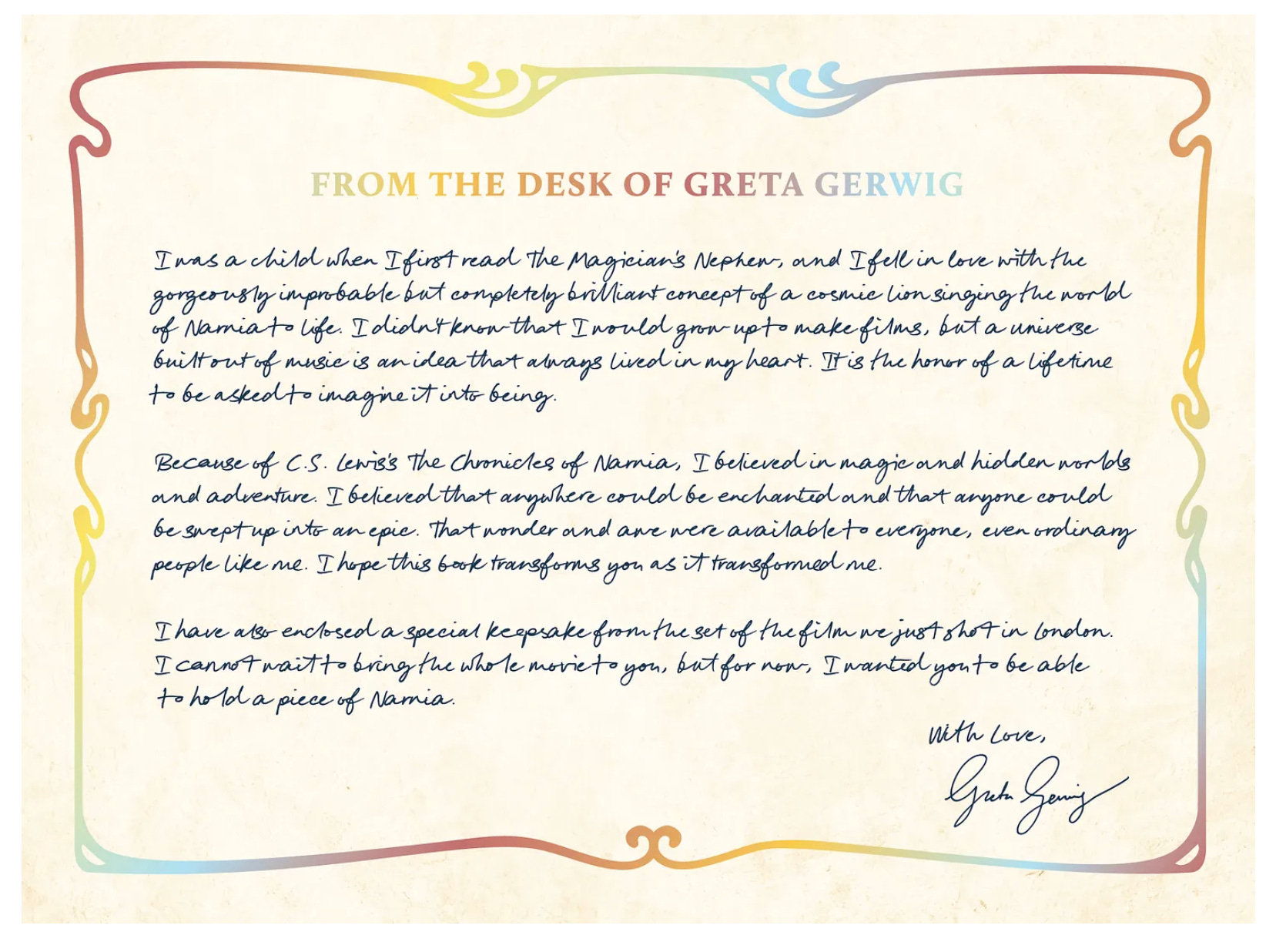
As you would imagine, there have been some fine online essays written about this drama. For example, see this from Samuel D. James at the Digital Liturgies website: “An Open Letter to Greta Gerwig.” Read it all, but especially note this:
Aslan is, of course, much more than a voice. Most people know that Aslan is a symbol of Jesus. Lewis, when asked to describe how the idea of Narnia came to him, said that he simply asked himself one day if there were worlds other than ours, how would the kind of story God tells in the Bible be told in that world. That’s why, whenever Aslan appears in the stories, or even is mentioned by name, Lewis makes a point of stopping his characters in their tracks. Even the thought of him fills them with something: Wonder, joy, hope, for those who desire Aslan’s presence; fear, loathing, and rage, for those who hate it.
In other words, Aslan is not just a wise lion. He’s not just a powerful character. He’s the point of Narnia. Aslan himself is the reason Narnia exists (as your adaptation of The Magician’s Nephew will hopefully show). Aslan appears when he does, not by chance, but by design. Digory, Polly, Uncle Andrew, Jadis, the Pevensie children, Caspian, Eustace Scrubb, and everyone else — all of their adventures, their tears, their self-discovery, their fall and their rising, is all about Aslan. He wills all of it. He works everything out for the ultimate good. …
Your casting of Ms. Streep raises an interesting question: Why did Lewis depict Aslan as a lion, rather than a lioness?
This is getting long.
Thus, I will end — for now — with this piece by a friend of mine, Joel J. Miller of greater Nashville. He is convinced that, at this point in the Narnia wars, many people who love the work of Lewis (Miller is clearly a member of that throng) have gone ballistic — a bit early.
You will want to read all of his piece at the must-bookmark Miller’s Book Review website. But here is part of “Greta Gerwig’s Narnia — The Freak-out Edition.” The following is a bit long, but essential:
There’s something odd about treating the existence of a movie you might dislike as an injury somebody has inflicted upon you. Love her or loathe her, Gerwig hasn’t taken anything away from anyone. An adaptation is definitionally additive, not subtractive. Meanwhile, people are acting as if they’ve been violated, like they’ve been robbed or betrayed.
Start with the claim that the film destroys Narnia, adulterates Lewis, or does violence to his creation. Yeah, but no. A movie is a new work. The original remains on the shelf, exactly where you left it. An adaptation doesn’t overwrite the books, alter your copies, or require you to accept its interpretation; you don’t even have to pay any attention to it. Whatever Gerwig does, she can’t reach back into the book and change it. And if she botches the film, Lewis’s world is still right there, working the same wonderful magic it always has and will. …
Of course, a movie can distort people’s understanding of a book. Maybe some viewers will only encounter the story on screen. That’s a good reason to explain the pluses and minuses of any adaptation and introduce people to Lewis’s original. If we want our children to know Narnia, we should read it with them. Leaving that job to Greta Gerwig and then griping about her performance is significantly more bizarre than casting Meryl Streep as Aslan.
Then there’s the theological objection. This makes some sense, but I also think the ire is over dialed. I have no trouble understanding why people care about this. After all, Aslan is central to the Christian meaning of Narnia, and a film could certainly flub it. Lewis himself worried about that very thing. But are we talking blasphemy here? I don’t think so. …
Narnia works with sacred themes; it’s not a sacred text. Aslan is a Christ figure, a type, something that points to Christ. He’s not a depiction of Christ himself, and the fact we can’t tell the difference between Aslan and Jesus is … maybe a little concerning. Besides, Gerwig’s Aslan isn’t even Aslan. Per my point above, it’s Gerwig’s Aslan. The real Aslan remains untouched.
I agree with much that Miller has to say. However, I think — after decades of teaching mass media — that it is crucial to grasp that we have lived in a visual age for 50 years or more. That’s the reality.
Visual grammar is vague, but powerful. A picture is worth a thousand words, but which words? For the vast majority of postmodern people, churched and unchurched, books are now secondary. And the grammar of the visual is technologically hostile to that of print, to linear arguments and, yes, to the concept of doctrine.
That’s tragic. Truth is, I meet 10 people who have seen the Lord of the Rings movies for each person who has read the Tolkien tales, for real. With the Harry Potter canon the ratio, in my experience, is about 25 movie viewers for each book reader.
If people have read the original books, they tend to know what is going on.
But millions and millions will never read the books. Netflix leaders have made their decision, which was their decision to make. Millions of people who will never read what Lewis has created in “The Chronicles of Narnia” will now have a magical Woodstock Aslan, in all of her-his rainbow glory.
The ball is now in the court of the CS Lewis estate. We have, of course, zero way to know what is written in the legal contracts.
Finally, Miller makes this important and valid point, to which I will respond in a shorter post later this week.
Walden Media discussed making The Magician’s Nephew back in 2011, but that proposed version fizzled for whatever reason. (Could be their first tries weren’t so impressive. Compare them, for instance, to Peter Jackson’s LOTR treatment, which it’s worth saying, many LOTR fans still hated despite the adaptations’ merits.) Regardless, Netflix and Gerwig actually got it produced.
Christian audiences, filmmakers, and investors who want different movies have their work cut out. Witness what the folks at Angel Studios are doing; they offer an innovative model to follow. What they demonstrate above all else? The desire for cultural influence ought to produce something besides complaints about the people who have it and what they make with it.
Yes, it is not enough to scream complaints.
This brings us back to a question that has haunted me during all of my decades in higher education. Why are so many “Christian” movies and productions for television, to be kind, weak efforts to preach to a choir that is much smaller than the audience reached by the Inklings?
From a faithful reader who sends things to me rather than using comments.
Here is a list of ways I would like to respond to Greta Gerwig’s version of The Magician’s Nephew:
Take in an evening of excellent Lewisian theater instead. Max McLean’s Fellowship for the Performing Arts lists its productions in America’s larger cities from mid-October to March:
https://fpatheatre.com/
Watch Lady Bird (2017), a film by Gerwig that treats Catholicism with respect.
Research what little Meryl Streep has said about faith and contrast it with anything said by Aslan on the same broad topic.
As a thought experiment, choose any film starring Meryl Streep, change the sex of the character she played, and ponder how that affects the character and the story.
Arrange an evening’s talk or a weekend conference featuring Louis Markos, Holly Ordway, or Ralph Wood to spread a better understanding of C.S. Lewis and his imaginative works.
Resist paying anything to see this film, or any other film that almost certainly will be exhausting.
Pray that Greta Gerwig and Meryl Streep will somehow be drawn closer to God even amid this clash of artistic visions and ways of understanding Lewis’s allegory.
And I will never watch such a version of Narnia. After it flops no one else will watch it either. Woke kills all it touches.