

Thinking about wedding nights ...
While viewing this subject through the cultural lens of The New York Times

I have spent four decades or so studying how the mainstream media cover (or fail to cover) religion news. Thus, I have heard conservative news consumers make the following statement more than any other when explaining why they think so many journalists just don’t “get religion.”
“They hate religious people,” folks say. Then many add, “They really hate Christianity.”
On the 10-year anniversary of my 1983 Quill journal cover story about why newspapers avoid covering religion, I wrote a follow-up piece that directly addressed this issue: “Religion and the news media — Have our biases fatally wounded our coverage.” It was based on a lecture delivered to the managing editors of the old Scripps Howard News Service, where my national “On Religion” column was born.
I bring this up because, in contacts with Rational Sheep readers, I frequently hear these same statements when talking about religion and the mainstream media in all of its forms (especially movies and television from elite Hollywood).
Before I get to those biases, let me share a small item that the must-follow Leah Libresco Sargeant (author of the Other Feminisms Substack) posted the other day on X. If you don’t know her atheist-to-Catholic story, please see this “On Religion” column: “Beyond tweets and text messages: Many young believers evolve into accidental hermits.”
Leah’s witty tweet offers us a wink-wink window into these old “bias” questions, via the most elite of the elite newsrooms — The New York Times. Here’s that tweet:
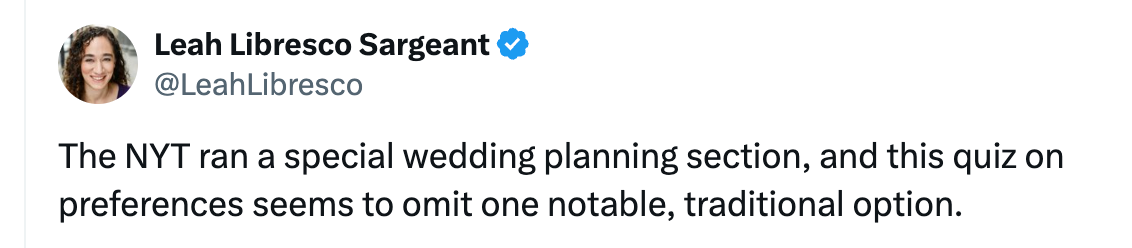
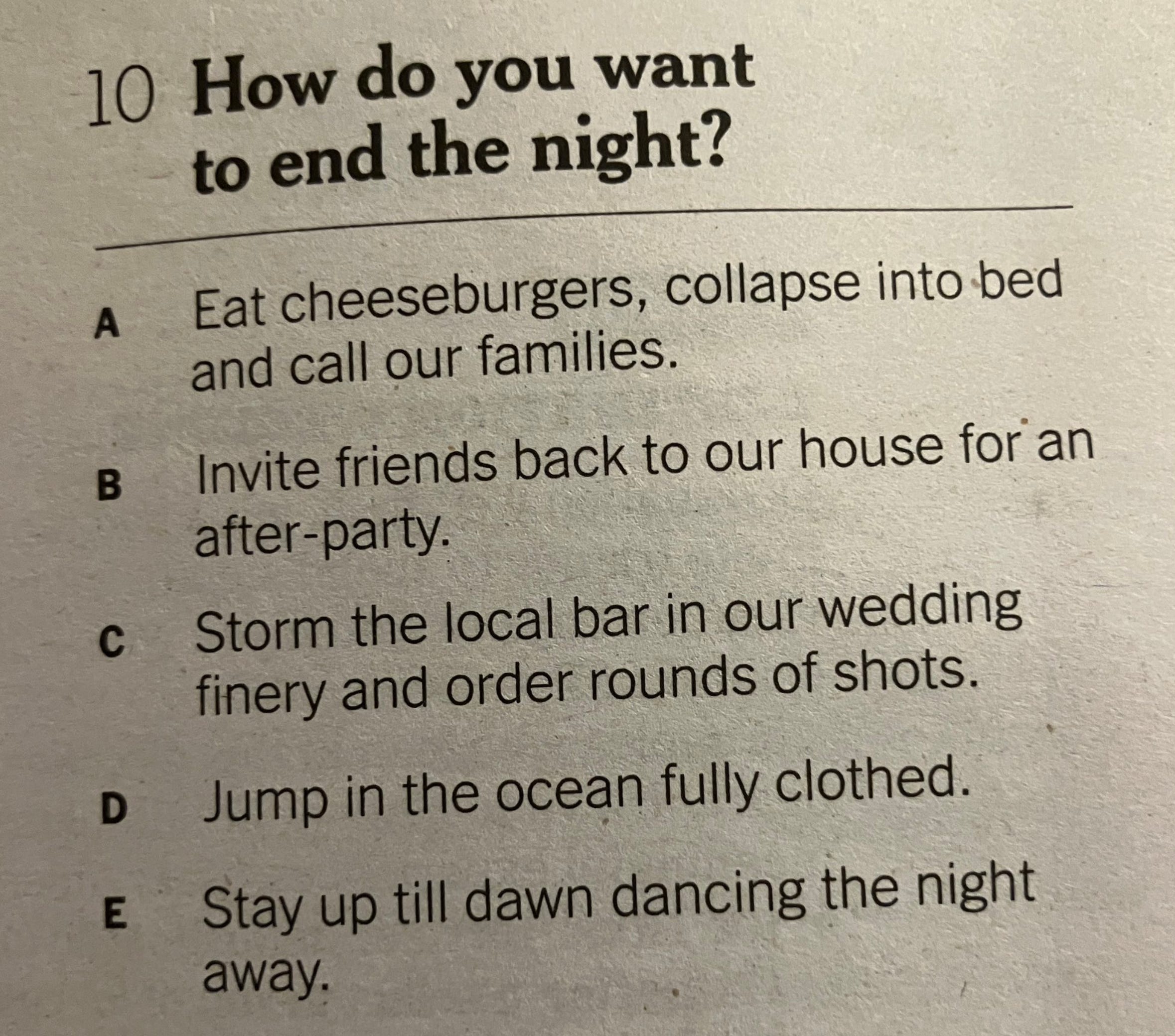
The final question in the perfect wedding-day quiz: How do you want to end the night? Rather than type up that item, here is the screen-shot that was in her tweet.
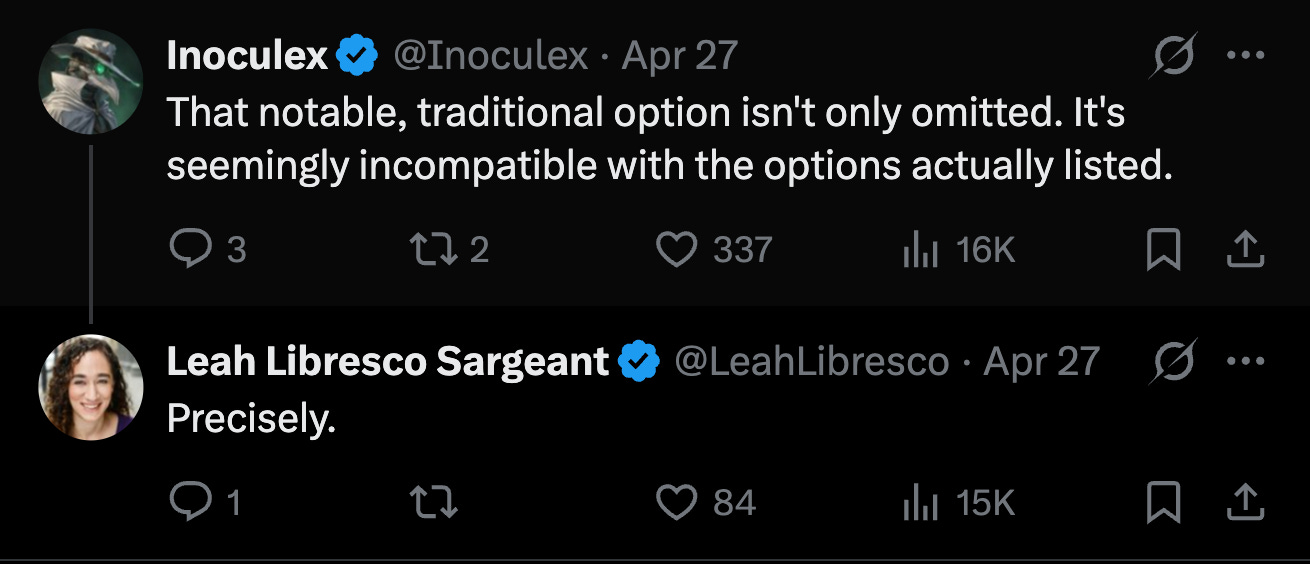
The comments thread on that tweet is worth scanning, but I selected these two items to point us back into the topic of the media wrestling with topics linked to religion and the lives of religious believers.
What wedding-night option is missing from this New York Times list?
Also this:
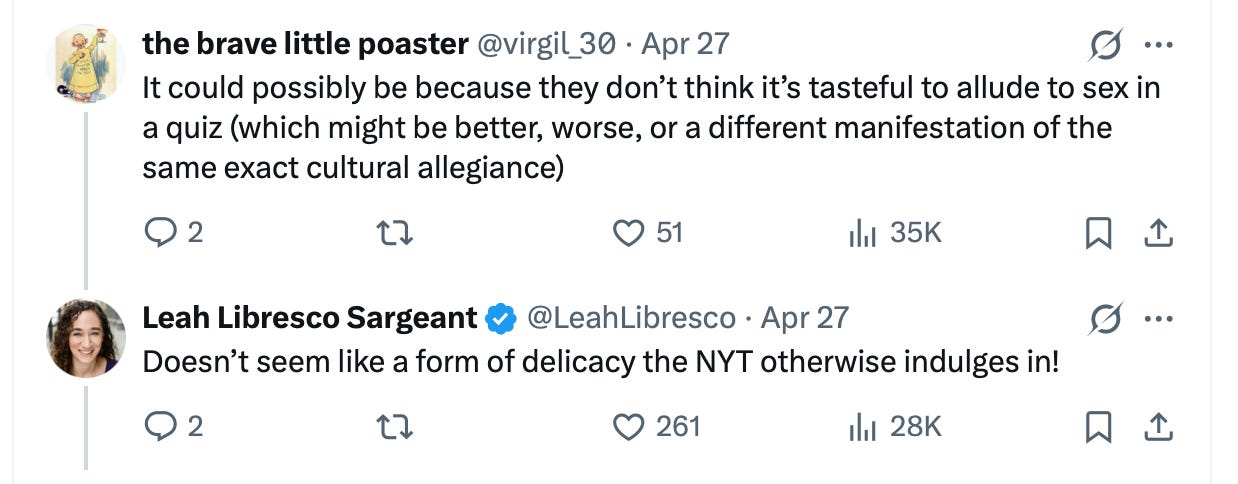
Leah has a point. The great Gray Lady does seem to print quite a bit of candid material on the subject in its sacred pages. Scan this packed search file, which opens with a 2026 headline: “Want to Have Better Sex This Year? Here’s How.”
Now, this wedding-night item is a rather silly little thing, but it does seem to assume that there is no need to consider the beliefs and behaviors of people who strive to follow the moral teachings of several traditional forms of religious faith.
So, was the Times mocking religion in this silly little item?
To address that, I need to point Rational Sheep readers back to what I believe was one of the most important posts (and podcasts) in the 20-year history of GetReligion.org, which ran with this headline: “Once again — Do journalists believe there is good religion and then bad religion?”
It included an appeal for readers to consider part of a great 2004 PressThink piece by Jay Rosen of New York University called “Journalism Is Itself a Religion.” The massive subtitle for that essay included this: “The newsroom is a nest of believers if we include believers in journalism itself. There is a religion of the press. There is also a priesthood. And there can be a crisis of faith. ...”
What are the core doctrines of this journalism “faith”? Consider the section that Rosen calls, “The Orthodoxy of No Orthodoxy.” This is long, but essential:
Ninety percent of the commentary on this subject takes in another kind of question entirely: What results from the “relative godlessness of mainstream journalists?” Or, in a more practical vein: How are editors and reporters striving to improve or beef up their religion coverage?
Here and there in the discussion of religion “in” the news, there arises a trickier matter, which is the religion of the newsroom, and of the priesthood in the press. A particularly telling example began with this passage from a 1999 New York Times Magazine article about anti-abortion extremism: “It is a shared if unspoken premise of the world that most of us inhabit that absolutes do not exist and that people who claim to have found them are crazy,” wrote David Samuels.
This struck some people as dogma very close to religious dogma, and they spoke up about it. One was Terry Mattingly, a syndicated columnist of religion:
This remarkable credo was more than a statement of one journalist’s convictions, said William Proctor, a Harvard Law School graduate and former legal affairs reporter for the New York Daily News. Surely, the “world that most of us inhabit” cited by Samuels is, in fact, the culture of the New York Times and the faithful who draw inspiration from its sacred pages.
Yet here is the part that intrigued me:
But critics are wrong if they claim that the New York Times is a bastion of secularism, he stressed. In its own way, the newspaper is crusading to reform society and even to convert wayward “fundamentalists.” Thus, when listing the “deadly sins” that are opposed by the Times, he deliberately did not claim that it rejects religious faith. Instead, he said the world’s most influential newspaper condemns “the sin of religious certainty.”
In other words, it’s against newsroom religion to be an absolutist and in this sense, the Isaiah Berlin sense, the press is a liberal institution put in the uncomfortable position of being “closed” to other traditions and their truth claims — specifically, the orthodox faiths. At least according to Mattingly and his source:
“Yet here’s the irony of it all. The agenda the Times advocates is based on a set of absolute truths,” said Proctor. Its leaders are “absolutely sure that the religious groups they consider intolerant and judgmental are absolutely wrong, especially traditional Roman Catholics, evangelicals and most Orthodox Jews. And they are just as convinced that the religious groups that they consider tolerant and progressive are absolutely right.”
The apparent orthodoxy of forbidding all orthodoxies is a philosophical puzzle in liberalism since John Locke. Journalists cannot be expected to solve it. However, they might in some future professional climate (which may be around the corner) come to examine the prevailing orthodoxy about journalism — how to do it, name it, explain it, uphold it, and protect it — for that orthodoxy does exist. And it does not always have adequate answers.
I concluded: “In other words, most members of this elite journalistic priesthood are absolutely sure that they are speaking the absolute truth when they affirm that there are no absolute religious truths. So there.”
That would include any crazy doctrines and “absolutes” linked to wedding nights.
Oh, and if you want to know more about what Proctor was saying, see this 2001 column — “The Gray Lady’s gospel crusade” — that focuses on his book, “The Gospel According to the New York Times.”
What is the main takeaway here, if we are parsing the wedding-night Times quiz?
Obviously, those who, to quote Samuels again, live in the “world that most of us inhabit,” cannot imagine a union between two traditional religious believers who assume that their wedding night has something to do with, you know, Bible verses such as Genesis 2:24, Matthew 19:5, Mark 10:8, etc., etc.
What kind of “bias” are we talking about, when dealing with this blind spot that exists in the most powerful newsrooms in our culture?
Well, it isn’t a bias against religion, is it? There are plenty of religious believers whose progressive, evolving views do not offend the reporters, editors and producers in these institutions. Paging sociologist James Davison Hunter? If you follow the news offered by the Times, as serious news consumers tend to do, you know that there are Catholics who draw cheers and there are Catholics who receive jeers. Orthodox Jews vs. progressive Jews? “Alternative” Anglicans vs. Episcopalians? You get the picture.
Is this simply a matter of hatred or simple “prejudice”? In the 1993 feature for The Quill, I argued that — in my experience — “prejudice” is the weakest of the biases that often warp coverage of religion news and, especially, traditional religious believers.
Thus, I described four important forms of bias. Again, this is long, but essential (#IMHO).
* The bias of space, time and resources. Simply stated: You cannot print a story if you have little space in which to print it, time to write it, or the money to hire a professional to do so.
An example: In 1983 I received a series of anonymous calls from a PTL Club insider. He offered proof of a scandal involving Jim Bakker, but he said we must meet in an airport far from Charlotte. My editors said there were few, if any, funds for religion travel. The source refused a local meeting and signed off by saying: “Just remember this name — Jessica Hahn.”
Many editors insist resources are too thin to support professional religion coverage.
* The bias of knowledge. Fact: You cannot write a story if you do not know that it exists. …
I saw a feature article on prayer based on quotes from three small-church pastors in Denver. The newspaper’s region included at least four internationally known groups that specialize in prayer ministries, yet their leaders were not quoted. The big question: Did anyone in the newsroom know these groups existed? …
* This leads to the bias of worldview. Simply stated: It is hard to write a good story if you don’t care that it exists. The result is, at best, a blind spot on religious issues, and the people who care about them.
A now infamous case came … when The Washington Post printed a story that said evangelical Christians are “largely poor, uneducated and easy to command.” A Post correction bluntly said there was “no factual basis” for this statement. Reporter Michael Weisskopf repented, sort of, and said he should have written that evangelicals are “relatively” poor, uneducated and easy to command.
Post ombudsman Joann Byrd made the following point: “When journalists aren’t like, or don’t know, the people they are writing about, they can operate with no ill will whatsoever and still not recognize that a statement doesn’t ring true. It may be even harder to see how deeply offensive a common perception can be.” …
* Finally, there is the bias of prejudice. It’s hard to produce balanced, fair coverage of people you dislike, distrust, or whom you feel are irrelevant.
Read that Byrd quote again.
My conclusion: “I am convinced that the first three biases play greater roles in shaping religion coverage, with the ‘bias of worldview’ being the most important.”
Yes, there is a thin line between the bias of knowledge and the bias of worldview. You can see that in a famous (and frequently misquoted) statement made by critic Pauline Kael of The New Yorker. After the 1972 Presidential election, she noted: “I live in a rather special world. I only know one person who voted for Nixon. Where they are I don’t know. They’re outside my ken. But sometimes when I’m in a theater I can feel them.”
What kind of bias shaped the options in the New York Times wedding-night quiz? Let me know what you think in the comments section. Be nice.
FIRST IMAGE: Wedding cake topper for sale at Etsy.com
Surely the simple answer is that at least entertainment media-wise we’re surrounded by the perception that everyone’s already having sex long before marriage, and there’s no part of that content that shows wedding-night sex as different from regular sex. Combine that with the fact that all couples, married or otherwise, are having less sex than they used to, and I can see why the quiz writer didn’t see anything noteworthy about sex to end the wedding day.
Back to the original issue: there is no choice “F. Make love all night long with my beloved.” — because the couple already “knows “ each other. Choices A thru E demonstrate a disordered society. The couple not only doesn’t know each other, they also don’t know what’s going on, and ultimately going wrong.