

Connecting some depressing dating dots
Are religious leaders actually worried about marriage and fertility trends?

Let’s start with a question: Have you heard leaders in your congregation discuss any of this information in a setting that will reach active members, as opposed to special events that draw the “usual suspects” in the flock (maybe 10-20% of members) that attend just about everything?
OK, I intentionally left a crucial hole in that question — the vague “this information” reference. Why did I do that? Because the online dots I want to connect are too complex to describe in a tiny cluster of words.
Early in the Rational Sheep timeline, I noted that I understand readers do not have lots of extra time to read everything online that they probably want to read or even need to read. This is especially true for super-busy clergy, parents with children, tired teachers with work to grade, etc.
Trust me: I know that. I don’t have enough time and energy to read everything that I want to read. But I manage to read quite a bit and I want to pass some of that along to readers who support this project. Thus, early on, I said that — every now and then — I would try to craft posts that expose Rational Sheep readers to pieces of crucial information, and URLs, that I believe pastors, parents, teachers and counselors truly need to see.
Thus, there are the “think pieces” that I usually run on weekends, in which I point readers to a specific online feature while adding my own commentary and, often, bytes of related information (such as “On Religion” columns from my past).
This post will be long, but I have done what I can to condense the information, while allowing readers (who have extra time) to follow links to the complete articles. Once again, I want to connect Rational Sheep dots.
Start here, with an Aaron Renn link pointing readers to a must-read article by Joshua Konstantinos, author of “Sleeping on a Volcano: The Worldwide Demographic Decline and the Economic and Geopolitical Implications.” That sobering Aporia headline: “Sterile Polygamy — The mating system we accidentally built.”
The subject, of course, is the implosion of marriage and fertility numbers — in America and many other parts of the industrialized world. Konstantinos starts with this haunting summary:
You may not have noticed, but we’ve invented a new mating system. It has the sexual inequality of polygamy with fertility closer to a celibate religious order. The harem without the children. The monastery without the prayers.
No one announced this revolution. There was no manifesto, no movement, no moment when the old order ended and the new one began.
Basically, the institutions of family and civilization are crashing on a superhighway coated with ice. What is the ice? Technology, of course, primarily (#DUH) smartphones and social media.
Boil these two developments into a “crystal meth” form and you have dating apps carried in pockets and purses (rarely in the presence of Bibles). That leads to this disaster zone:
On dating apps, women’s average match rate is 31%; men’s is 2.6% — a 12-fold difference. The most desirable men receive overwhelming attention while the majority receive almost nothing.
In South Korea, the 4B movement (no dating, no sex, no marriage, no childbirth) has contributed to the lowest fertility rate ever recorded: 0.72 children per woman. Deaths outnumber births. In Japan, 40% of never-married adults aged 18-34 have never had sex. The population is projected to fall from 124 million to 87 million by 2070.
If you’re older than 45, you likely live in a world where people still got married. The figures above may feel like dispatches from another planet. They’re not. They’re dispatches from the other half of your own country. Among women born in 1980, 71% of college graduates were married by 45. Among those without degrees, it was only 52%. Marriage has become a luxury good. And all groups are converging toward the same destination: below replacement fertility.
That did all of this technology replace? Read this next part carefully (I added bold italics):
In 2012, Tinder launched with a simple innovation: the swipe. Left for no, right for yes. The interface was deliberately game-like — the same variable reward mechanism that makes slot machines addictive. Within two years, the app was processing a billion swipes per day.
The designers had built something more consequential than they knew. Before Tinder, you met partners primarily through work, church and friends. You screened maybe fifty or a hundred realistic candidates over the course of your twenties. And there were still social costs attached to promiscuity.
Tinder changed things. Suddenly women had access to every male user within a fifty-mile radius — thousands of candidates, sorted by attractiveness, available for private evaluation, with zero social cost. And here’s the thing about this kind of rating system: the same people rise to the top.
The data is stark. Analysis of dating app behavior shows that women like about 14% of male profiles, whereas men like 46% of female profiles. The result is that a small percentage of men receive the vast majority of female attention. The top 10% of men get over half of all likes. The bottom 50% of men get about 5%.
Now, if you have read Jane Austen (“Darcy, Lizzy and the moral vision of Jane Austen”) you know that, quite frequently, the men who look good often turn out to be, well, shallow, warped and undependable. Then there are the solid, normal, dependable and, often, complex other men.
Tinder and Jane Austen do not get along. Ditto for Tinder and Holy Scripture.
This leads to a devastating variation on the theme in the article’s overture:
We’ve invented something different: effective polygamy without children. High-status men cycle through partners, but nobody reproduces. Why? Because reproduction requires the lock-in that marriage provides. Serial dating offers men all the benefits of access with none of the costs of commitment. And women, waiting for commitment from men who have no incentive to provide it, delay childbearing until it’s too late.
If you follow Brad Wilcox on X, and Rational Sheep readers need to do that, you know that the Institute for Family Studies leader is constantly sharing symbolic bytes of information such as this:
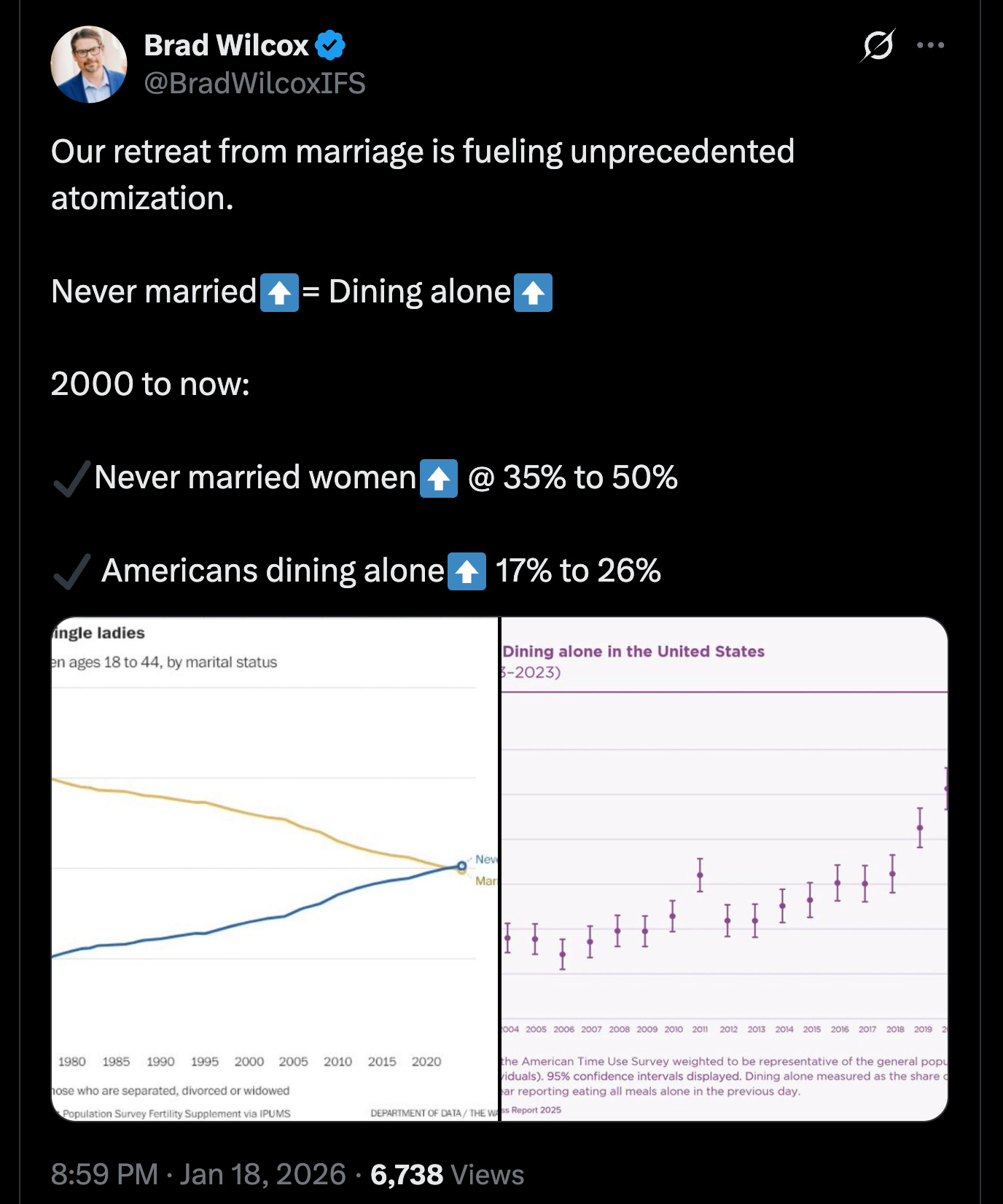
Sort of depressing, right?
This brings me to a tweetstorm on X that is the final connect-the-dots link in this post. The author is an online maven who uses this pen name — vittorio, with this motto, “biology will rage against the dying of the light.”
Long X threads of this kind — “tweetstorm” is the common term — can be intimidating to people who do not, well, spend quite a bit of time on that social-media platform. These threads are frequently packed with charts and URLs to even more data. This can be a bit overwhelming, at times.
In what follows, I have radically condensed this long thread in order to focus on the role that screens culture is playing in this tragic drama in our culture. The Big Idea is something that has been discussed, quite a bit, here at Rational Sheep — in “Crossroads” podcasts, think pieces and in stand-alone posts.
But this vittorio piece combines several important themes into one argument that, whether you agree with all of this or not, raises questions that pastors, parents, teachers and counselors will simply have to address. The future — of the church, at the very least — is at stake.
The headline on the vittorio thread: “Why Young Women Moved Left While Young Men Stayed Sane.”
Yes, “sane” is a loaded term. Read carefully and you will see that young men have, in the past decade or so, stayed where they were, in terms of key metrics about life, marriage and family. Oh, but screens culture has damaged them in several important ways. Hold that thought.
Let’s start here, in the vittorio thread.
Bill Ackman quote tweeted a graph showing the partisan gap between young men and women almost doubled in 25 years.
Women moved radically left. Men stayed roughly where they were.
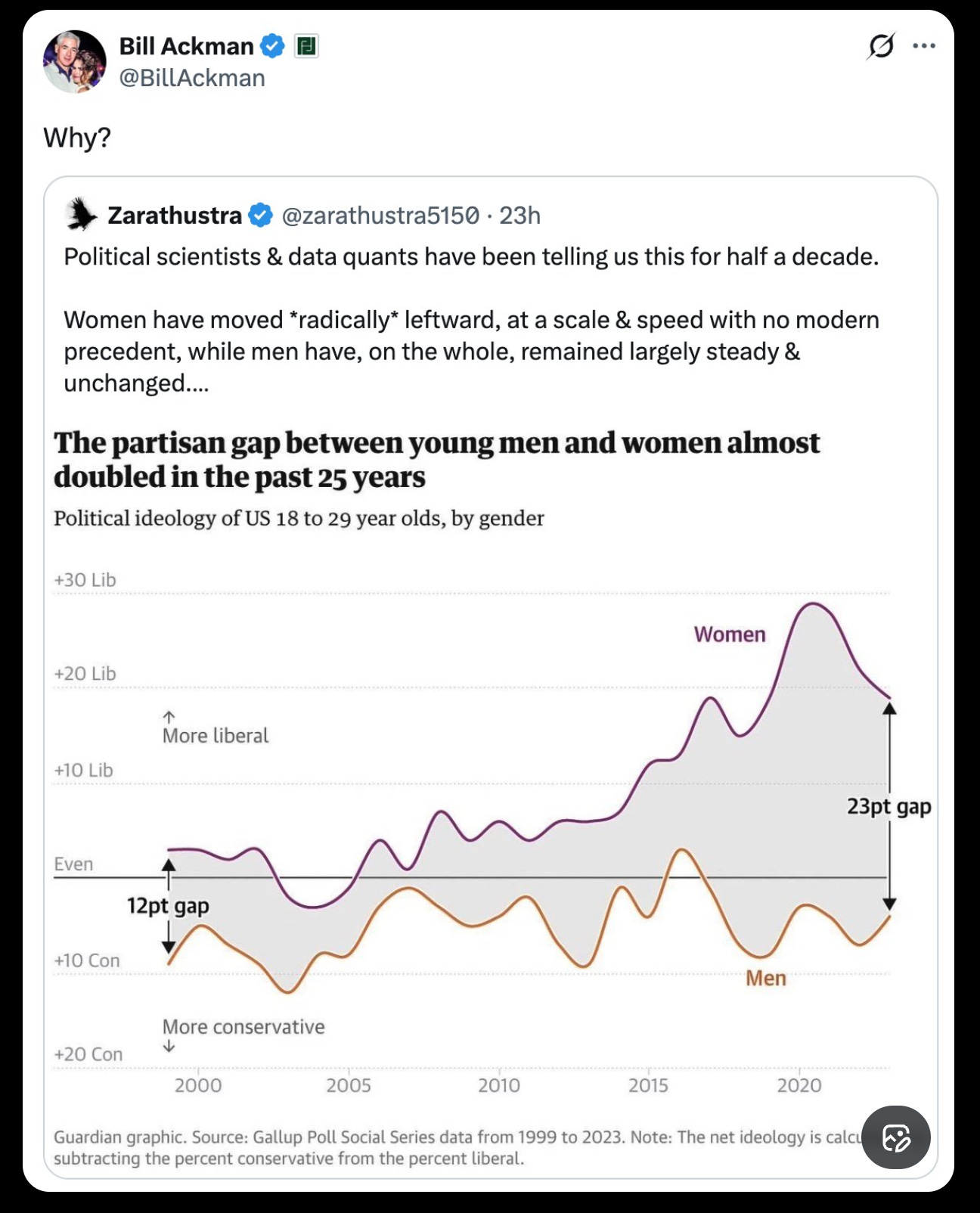
This part of the post will be quite long, but I have condensed things a bit. Look for the ellipses for clues on that.
Yes, everyone is asking, “Why?”
Good question. Most answers I’ve seen are either tribal (”women are emotional”) or surface-level (”social media bad”). Neither traces the actual mechanism.
Let me try. … We’ve been told for a decade that men are “radicalizing to the right” and that this is dangerous. The actual data shows the opposite. Men barely moved. Women moved 20+ points leftward.
The story we are told is exactly inverted from reality. And when female leftward movement does get discussed, it’s framed as progress: “women becoming more educated, more independent, more enlightened”
They’ll tell you the graph shows enlightenment and progress. Wrong.
The graph shows is capture.
Before getting into mechanism, something important: this pattern isn’t only American. It’s global. The Financial Times documented it last year. The gender ideology gap is widening across dozens of countries simultaneously. UK, Germany, Australia, Canada, South Korea, Poland, Brazil, Tunisia. Young women moving left on social issues, young men either stable or drifting right.
This matters because it rules out explanations specific to American politics. It’s not Title IX policy. It’s not #MeToo. It’s not the specific culture war of US campuses. Something bigger is happening, something that rolled out globally at roughly the same time.
What is the “machine” that is at work? On the timeline of tech and culture, everything points to the mass acceptance of smartphones and, then, the social media platforms that convert them into portable slot machines.
Again, I am condensing this quite a bit. Yes, this is all material that is available, in one form or another, at the essential After Babel website (using its search engine).
Back to the tweetstorm:
Social media is a consensus engine. You can see what everyone believes in real time. Disagreement is visible, measurable, and punishable at scale. The tribe used to be 150 people. Now it’s everyone you’ve ever met plus a world of strangers watching. …
Facebook launched in 2004 but was college-only until 2006. The iPhone launched June 2007. Instagram in 2010. Suddenly social media was in your pocket and in your face, all day, every day. …
Women were roughly stable through the early 2000s. The acceleration starts around 2007-2008. The curve steepens through the 2010s as smartphones became universal and platforms became more sophisticated. Women are by nature more liberal, but the radicalization coincides with the rise in smartphones adoption.
The machine turned on and the capture began.
The mental health collapse among teenage girls tracks almost perfectly with smartphone adoption, with stronger effects for girls than boys. The same vulnerability that made social exclusion more costly in ancestral environments made the new consensus engines more capturing.
This machine wasn’t designed to capture women specifically. It was designed to capture attention. But it captures people more susceptible to consensus pressure more effectively. Women are more susceptible on average. So it captured them more.
Add a feedback loop: women complain more than men. Scroll any platform and it looks like women are suffering more. Institutions respond to this because visible distress creates liability, PR risk and regulatory pressure. In addition, women are weaker and inevitably seen as the victim in most scenarios. The institutional response is to make environments “safer”. Which means removing conflict. Which means censoring disagreement. Which means the consensus strengthens.
The counterarguments get removed or deplatformed and the loop closes.
Some of arguments are, in major social-media settings, “deplatformed.” The bigger truth is that social-media algorithms analyze the arguments and only send true believers the ideas, information, statistics, infuriating opinions and stories that support what they already believe.
That creates waves of quick clicks! Thus, it’s the business model of our era (including in the world of mainstream journalism).
Because of news-media coverage, citizens that follow American politics have probably heard about the growing cultural gap between young men and women. People who care about the marriage-formation crisis and the global fertility gap can read between the lines and see connections.
However, here is another political story that, for those with eyes to see, has strong religious and moral implications. I am talking about the political gap that has formed between single women and married women, especially married women with children (and the more children they have, the wider the gap).
Now, vittorio claims that more single women vote than married women. Is this in terms of sheer numbers or a matter of percentages? That’s worth closer study.
Meanwhile, let’s return to the social-media part of this tweetstorm:
Algorithms optimize for engagement. Engagement means emotional response. Time on platform. Clicks. Shares. Comments.
Women respond more strongly to emotional content on average, they are more empathetic, they can be more easily manipulated with sad stories. … The machine learned this. It fed them content calibrated to their response patterns. Fear. Outrage. Moral panic. Stories about danger and injustice and threat and wars and “victims”.
Men got different feeds because they responded to different triggers. The algorithm doesn’t really have a gender agenda. It has an engagement agenda. But engagement looks different by demographic, so the feeds diverged.
Women ended up in information environments optimized for emotional activation. Men found alternatives: podcasts, forums, cars, wars, manosphere etc.
Now, after lots of information about women, this thread enters territory previously covered, at length, by Jonathan Haidt.
The bottom line: The stats show that recent developments in social media have had a greater impact on women. The evidence is that men were captured earlier in the computer age, with different hooks and with different side effects.
Thus, I will end with several clips on that subject, from the same tweetstorm. Let me stress that there are more charts, stats and arguments in the full thread.
Women got ideological conformity. Men got withdrawal. Porn. Video games. Gambling apps. Outrage content. The male capture wasn’t “believe this or face social death.” It was “here’s an endless supply of dopamine so you never have to build anything real.”
Different machines, different failure modes. Women got compliance. Men got passivity.
Obviously, this is part of the growing gap between young women and young men. Yes, this affects politics:
Post-2024 data shows young men shifting right. Recent surveys all show the same thing. Young men are now actively moving more conservative. …
[A]s the gap became visible and culturally salient, as “men are the problem” became explicit mainstream messaging, as men started being excluded from society because of lies, as masculinity, or the very thing that makes men men became toxic, men had to start counter-aligning.
The passivity is converting into opposition. The withdrawal is becoming active rejection. This doesn't mean men are now "correct" or "free". It might just mean they're being captured by a different machine, one optimized for male grievance instead of female consensus.
And, in the end:
The machines captured the half more susceptible to consensus pressure. Then they started capturing the other half through different mechanisms.
We’re watching the results in real time. Two failure modes. One graph. Both lines moving away from each other and away from anything healthy.
I don’t know how this ends. I don’t think anyone does.
The impact in churches? Think back to Rational Sheep headlines such as “Young men are flocking into pews,” “Gray Lady examines those Orthodox converts,” “AP says that conservative Catholics are growing too fast” and others.
The political angle will get the most news coverage, of course. I have argued that — for pastors, parents, teachers and counselors — the most important angle is the marriage-formation crisis. That takes us back to the headline at the top of this post: “Sterile Polygamy — The mating system we accidentally built.”
You may also want to see my 2022 “On Religion” columns linked to that crisis: “Old enough? Faith, family and America’s falling marriage statistics” and “Mature enough? Can congregations and clergy help young adults prep for marriage?”
Hopefully we have now plugged the “this information” hole in my opening question. Here is that question again:
Have you heard leaders in your congregation discuss any of this information in a setting that will reach active members, as opposed to special events that draw the “usual suspects” in the flock (maybe 10-20% of members) that attend just about everything?
Care to respond? Please let me hear from you in the comments pages.
In what world are religious leaders apathetic about the state of marriage, families and children, or afraid to discuss these subjects? Yes, responding will require learning to live as Rational Sheep in a world dominated by screens culture.
Interesting turn-around in these numbers. tradutionally men were all about women's looks while women were more about men's character-- or more crassly, their bank accounts. But maybe not? Did something change or was it always thus?
Terry, I’ve followed your work for many years and have deep respect for your contributions. On this issue, however, I believe your framing does not fully reflect the realities of women today. I lead a women’s network and closely track trends in female empowerment, and over the past decade the shift has been profound. With greater access to education and economic independence, women are no longer motivated to “settle.” Instead, they are seeking men who can bring grounded masculine leadership, emotional presence, and intentionality at a level higher than previous generations.
I agree with your broader premise, but my travels—including time spent in Korea—have made one thing clear: remnants of traditional patriarchy no longer resonate with young women. They do not want to be treated as secondary or self-sacrificing in the way their mothers often were. In fact, many explicitly say, “I don’t want my mother’s life.” This is true even for my daughters as well.
I also hear consistently that many men today struggle to initiate, take risks, travel, or lead relationally. This is not a moral failing, but it does signal a real need for coaching and mentorship to help men step more fully into connection and leadership with women.
I would welcome the opportunity to speak with you and share the trends we are observing firsthand. Women have changed dramatically in the last ten years. For relationships to thrive, men must evolve as well—learning to lead in ways that genuinely speak to the modern female heart.
Finally, I believe the church carries a profound responsibility to help men succeed in dating, marriage, and the formation of healthy families. This will require equipping men to meet women as they are today—rather than blaming technology, pop culture or social media. Men need practical tools, guidance, and formation that enable them to connect with women in new and meaningful ways, appropriate to the realities of modern life.
Shirin Taber, Executive Director, Empower Women Media
P.S. If you are open to it, I would love to continue the conversation with you. Feel free to reach out at:shirin@empowerwomen.media